
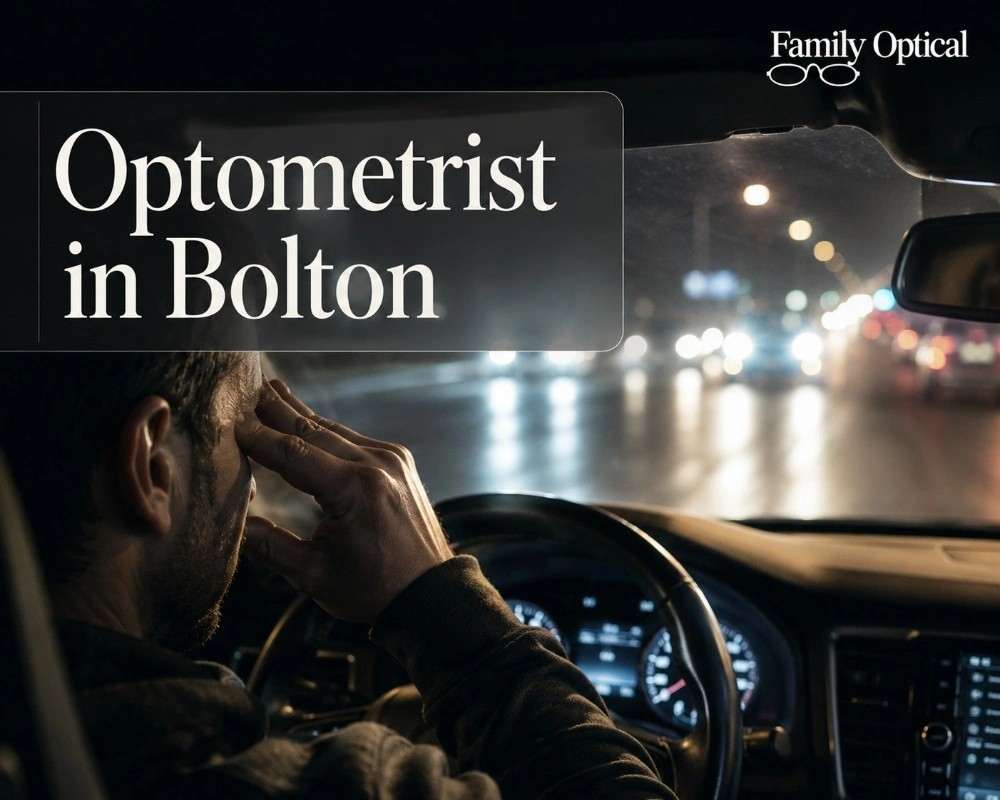
You walk into a dim room and can’t tell where the chair is. You drive home after sunset and spot the pedestrian at the last second. It’s frustrating. It can also feel a little scary.
These are common signs of night-vision trouble. But not every night-time struggle is true night blindness. Night blindness, also called nyctalopia, is a symptom. It can come from several different causes.
That’s why an eye exam matters. At Family Optical, we want you to understand what’s happening first. Then you can talk to an optometrist in Bolton about the right next step.
What Is Night Blindness?
Knowing how your eyes work in the dark makes the signs easier to spot.
How Night Vision Works
Your retina catches light and sends signals to your brain. It uses two types of cells. Cones handle colour and bright light. Rods handle dim light.
Rods rely on a pigment called rhodopsin. Your body needs vitamin A to make it. In the dark, your pupils also widen to let in more light. If your rods struggle, or light can’t reach them, your night vision suffers.
A Symptom, Not a Disease
Night blindness isn’t one single condition. It can come from retinal disorders, vitamin A deficiency or other eye problems. So the treatment depends on the cause. Finding that cause is the real goal.
Signs You Might Notice
Medical terms don’t help much on a dark staircase at 9pm. So here’s how it shows up in real life.
Dim Rooms Feel Impossible
- You can’t recognise objects in poorly lit rooms.
- Dark corridors or unfamiliar buildings feel hard to cross.
- You miss obstacles after sunset.
Slow Adjusting to Darkness
You step from a bright area into a dark room. For a while, you can’t see anything. Your eyes adapt more slowly than they should. Places where the lighting keeps changing feel especially hard.
Faces and Details Fade
Familiar faces blur in dim light. Objects blend into dark backgrounds. Small details simply disappear.
Moving Around After Sunset
- You bump into furniture.
- Poorly lit stairs feel unsafe.
- You avoid unfamiliar places after dark.
- Your confidence drops in low light.
Night Driving Feels Risky
Road signs, pedestrians and road markings are hard to spot. Anything outside your headlight beam disappears. Switching between dark and lit roads feels slow.
Glare and halos on their own aren’t automatically night blindness. They often have other causes.
Night Blindness or Night-Driving Trouble?
Many people mix these up. Here’s the difference.
What True Night Blindness Is
You struggle to see in dim light or darkness. Your eyes adapt poorly when you move from bright to dark. Your rod cells or retina may be involved.
What Headlight Glare Is
Bright headlights cause discomfort or a brief vision disturbance. You may see halos or streaks around streetlights. Cataracts or an uncorrected prescription can play a part.
What Low Contrast Means
You can still see a little in low light. But you struggle to separate objects from their background. Pedestrians in dark clothes are hard to spot. So are road markings.
Why the Difference Matters
Similar complaints can have very different causes. Each one needs a different assessment. You might have glare without night blindness. You might have night blindness without much glare. An eye exam sorts it out.
What Causes Night Blindness?
Inherited Retinal Conditions
Retinitis pigmentosa is an inherited condition. It damages the light-sensing cells in your retina. Poor night vision is often an early sign. Side vision can shrink as it progresses. It can start in childhood or appear later.
Congenital stationary night blindness is also inherited. It can be present from birth. Unlike retinitis pigmentosa, many forms stay stable.
Cataracts
A cataract clouds your eye’s natural lens. Less light gets through. Your vision looks blurry or dim. You may notice glare, halos and trouble driving at night.
Cataracts aren’t a retinal problem. Your optometrist will tell them apart from true night blindness.
Nearsightedness
Uncorrected myopia blurs distant objects. In dim light, that blur gets worse. An outdated prescription can add to it. The right glasses or contact lenses often help.
Vitamin A Deficiency
Your rods need vitamin A to make rhodopsin. Too little makes dim-light vision harder. Poor diet or poor absorption can cause it. Don’t self-diagnose. Get it properly assessed.
Other Eye Conditions and Medicines
- Glaucoma can affect your side vision.
- Other retinal disorders can interfere with low-light vision.
- Some medicines can affect night vision. Isotretinoin is one example.
- Past refractive surgery can sometimes add glare.
Tell your care team about every medicine you take. Report new symptoms quickly.
Ageing and Night Vision
As you age, your pupils get smaller. Your eyes adapt to the dark more slowly. Contrast sensitivity can drop. Cataracts add to the problem.
Still, don’t write off ongoing or worsening trouble as normal ageing.
Night Blindness in Children
It’s worrying when your child seems afraid of the dark. It may not be a bedtime fear. Their eyes might be struggling.
Behaviour Signs Parents Notice
- Your child hesitates before entering dark rooms.
- They avoid unfamiliar places in poor light.
- They bump into things after sunset.
- They can’t find toys in dim spaces.
- They take longer to adjust from bright to dark.
- They struggle with stairs or outdoor areas after dark.
Childhood Conditions Linked to It
Congenital stationary night blindness can be behind it. So can inherited retinal disorders. Some stay stable. Others may affect vision over time.
When to Book a Child’s Exam
Book an exam if:
- The difficulties keep happening.
- Your child struggles in familiar places in the dark.
- Other vision problems appear.
- Inherited retinal conditions run in your family.
What you observe isn’t a diagnosis. Only an exam can find the cause. Visit a trusted eye clinic in Bolton and ask for your child to be checked.
Does Diabetes Affect Night Vision?
If you have diabetes, new vision changes can be worrying. High blood sugar over time can damage the tiny blood vessels in your retina. This is called diabetic retinopathy.
Early on, it often causes no symptoms. Advanced damage can disturb your vision. That’s why regular diabetic eye screening matters.
But diabetes doesn’t automatically cause night blindness. So get any new night-vision trouble checked. Don’t just assume the cause.
How Is It Diagnosed?
Your optometrist looks for the cause, not just the complaint.
Your Symptoms and History
Expect questions like these:
- When did the problem start?
- Is it getting worse or staying the same?
- Does it affect one eye or both?
- Is your daytime vision affected?
- Do you notice glare or halos?
- Does anyone in your family have retinal disorders?
- Do you have conditions such as diabetes?
- Which medicines, supplements and foods are part of your routine?
Vision and Prescription Checks
A visual acuity test shows how clearly you see. It spots far-vision blur and other glasses issues. An outdated prescription can blur your vision in dim light.
Pupil and Retina Checks
Your pupil responses show how your eyes react to light. Drops may widen your pupils. Then your optometrist can inspect your retina and optic nerve.
This matters if inherited retinal disease or diabetic eye disease is possible.
Slit-Lamp Examination
A slit lamp gives a magnified view of the front of your eye. Your optometrist checks your cornea and lens. They check for cataracts and other problems that block light.
Extra Tests When Needed
- This test checks what you see sideways.
- ERG checks electric signals in your retina.
- Blood tests can check vitamin A levels.
- Specialist retinal assessment or genetic testing may follow for inherited conditions.
Not everyone needs every test. Your optometrist decides based on what they find.
When Should You See an Optometrist?
Book a Routine Eye Exam
Book an exam if:
- You struggle in dim light.
- Your night vision is slowly getting worse.
- Your eyes often adjust to dark slowly.
- Evening tasks feel harder than before.
- It makes driving or walking around hard.
Searching for an eye exam near Bolton? Family Optical can help. Book it sooner rather than later.
Get Urgent Help Fast
Seek urgent medical care if you notice:
- Sudden loss of vision, or a big drop in it.
- New flashes of light or a sudden rise in floaters.
- A dark curtain or shadow across your vision.
- Severe eye pain or sudden visual changes.
These aren’t routine night blindness. They can need urgent assessment.
Why Waiting Costs You
Waiting can leave the cause hidden. Some retinal conditions progress. Treatable problems go untreated. Poor vision also raises your risk of falls and accidents.
Can Night Blindness Be Treated?
Sometimes, yes. It depends on the cause.
Fixing Your Prescription
If a refractive error is behind it, an updated prescription helps. New glasses or contact lenses can sharpen your low-light vision.
Cataract Surgery
Cataracts scatter and block light. When they affect daily life, your doctor may recommend surgery. Taking out the cloudy lens can help you see better.
Managing Vitamin A Levels
First, find the deficiency and its cause. Then address your diet or absorption problem. Take supplements only with medical guidance. Too much vitamin A can be toxic.
Inherited Conditions Need Specialists
Retinitis pigmentosa and congenital stationary night blindness need condition-specific care. Checking often matters. Eye specialists and gene tests may help. Options differ from one condition to another.
Why the Cause Matters
Some causes are fixable. Others need long-term management. No one can promise that every case reverses. A proper exam gives you honest answers.
Getting Ready for Your Exam
Track Your Symptoms
Note down:
- When it started.
- Whether it happens in all dim places or only some.
- Whether it’s getting worse.
- Which eye is affected, or if it’s both.
- Any glare, halos or daytime changes.
Share Your Health History
Tell your optometrist about:
- Diabetes or any other health problems.
- The medicines and supplements you take.
- Past eye conditions or eye surgery.
- Family history of night blindness or retinal disease.
- Any nutrition concerns.
Describe Real Situations
Don’t just say “poor night vision.” Say “I can’t see the stairs at home after dark.” Real examples help your optometrist find the cause faster.
Get Checked at Family Optical
You’ve read the signs. Now it’s time to get answers.
Eye Exams at Family Optical
Family Optical has served Bolton since 1998. Susan Joseph runs the Bolton store with over 30 years of experience.
A full eye exam checks how clearly you see. It also checks how healthy your eyes are. If you need more tests or a specialist, the team helps you work out the next step. Night-vision concerns matter for adults and children alike.
Book an Optometrist in Bolton
Visit Family Optical in Bolton:
- Address: 12612 Highway 50, Unit 5, Bolton, ON L7E 1T6
- Eye exam direct line: 905 857 7830
- Store phone: (905) 857 5556
- Email: info@familyoptical.ca
- Hours: Mon 10am to 6pm, Tue to Thu 10am to 6:30pm, Fri 10am to 6pm, Sat 10am to 4pm, Sunday closed
You can also book online at familyoptical.ca. Don’t wait for your night vision to get worse.
Struggling to see after dark isn’t something to brush off as ageing or ordinary night-driving discomfort. An eye exam can find the cause and show you what to do next. If your prescription is part of the problem, Family Optical can also help you choose eye glasses in Bolton that suit your vision and your style. Call today and start seeing clearly again.