
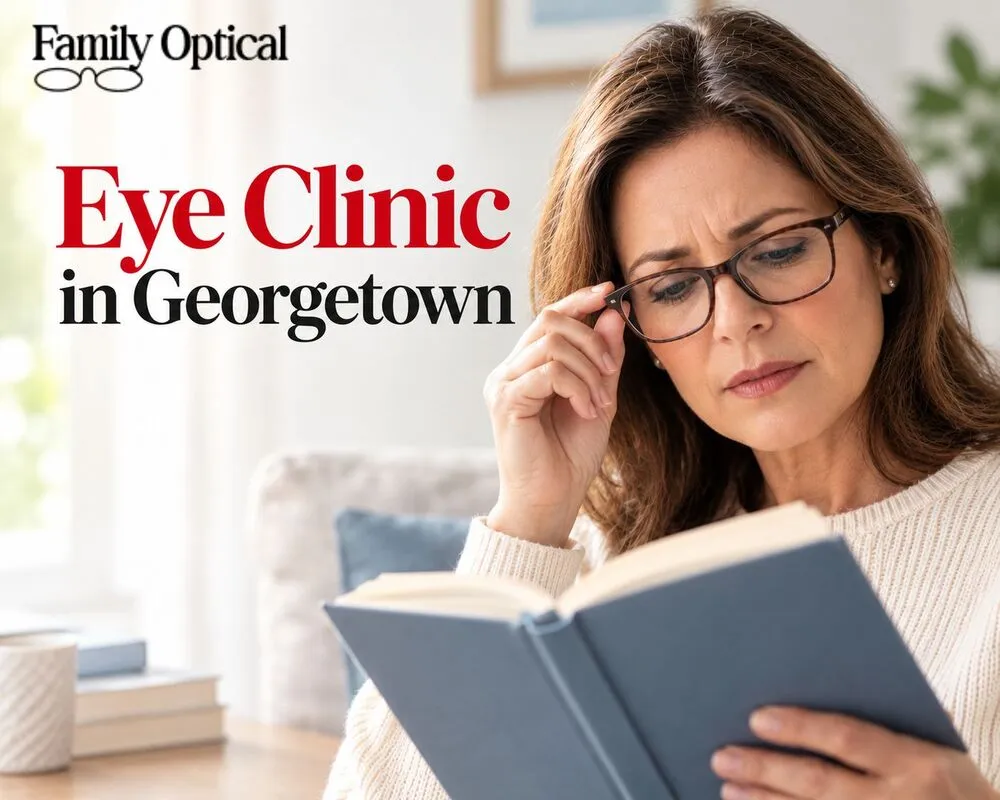
You hold the menu a little further away. You squint at your phone. You ask someone else to read the fine print. If this sounds familiar, you’re not alone. Most people notice this shift sometime after 40, and it has a name: presbyopia. At Family Optical, our eye clinic in Georgetown sees this exact concern almost every single day, and the good news is, it’s completely manageable once you understand what’s happening.
What Is Presbyopia, Really?
Presbyopia isn’t an illness. It’s not something you did wrong. It’s simply your eyes changing as you age.
Inside your eye is a small, flexible lens. When you’re young, that lens bends easily. It lets you shift focus from a street sign to a text message in a split second. Over time, that lens naturally stiffens.
Here’s what that means for you:
- Reading small print becomes harder
- You need brighter light to see up close
- Your arms feel “too short” for comfortable reading
- Eye strain and headaches creep in after close work
This isn’t the same as being nearsighted or farsighted. It’s a separate, age-related change that eventually affects nearly everyone.
Why Does This Happen After 40?
Your eye’s lens is made of protein fibers, and like most tissues in your body, they lose elasticity over time. Around your early-to-mid 40s, that stiffness reaches a point where your near vision starts to blur.
The cause is simple aging. But the frustration it causes is very real.
You might not notice it right away. Then one day, the restaurant menu looks like it’s written in another language, and you’re holding it at arm’s length just to make sense of it. That’s presbyopia announcing itself.
The solution isn’t complicated. Once you know what’s going on, there are clear, comfortable ways to fix it.
Signs You’re Struggling to Focus Up Close
It helps to know exactly what to watch for. Presbyopia tends to show up gradually, so the signs can be easy to brush off at first.
Common signs include:
- Holding books, menus, or phones further away than usual
- Needing more light to read comfortably
- Blurry vision when switching between near and far objects
- Frequent headaches after reading or screen time
- Tired, strained eyes by the end of the workday
If two or more of these sound familiar, it’s worth getting your eyes checked. Ignoring it usually just makes daily tasks more tiring than they need to be.
Some people push through it for months, thinking it’s just tiredness or stress. But squinting to read a label or leaning back from your laptop screen all day adds up. It affects your focus at work, your patience while reading with your kids, and even how relaxed you feel by evening. There’s no reason to keep working around a problem that has a straightforward fix.
Common Myths About Presbyopia
There’s a lot of confusion around presbyopia, and most of it makes people put off getting help. Let’s clear a few things up.
Myth: Only “old” people get presbyopia. Truth: Most people notice it starting in their early-to-mid 40s. It’s a normal life stage, not a sign of poor health.
Myth: If you’ve never worn glasses, you won’t need them now. Truth: Presbyopia affects your near vision specifically. Even people with perfect distance vision their whole life often need reading help once they hit their 40s.
Myth: Reading glasses from the pharmacy work just as well. Truth: Off-the-shelf readers give you a generic strength for both eyes. Your eyes are rarely identical, so a proper prescription almost always feels more comfortable and reduces strain.
Myth: Presbyopia will get better on its own. Truth: It won’t. It typically progresses gradually until around your mid-60s, when it usually stabilizes. Getting the right correction early just makes daily life easier while it does.
Finding the Right Eye Clinic in Georgetown for Presbyopia
Not every eye exam is the same, and presbyopia deserves proper attention. A thorough exam checks more than just your reading ability. It looks at your overall eye health, prescription changes, and lifestyle needs.
When you visit an eye clinic in Georgetown, here’s what a good presbyopia check should include:
- A full vision and eye health assessment
- Testing your near, intermediate, and distance vision separately
- A conversation about how you actually use your eyes each day
- Recommendations based on your lifestyle, not a one-size-fits-all fix
It’s frustrating to feel like your vision is working against you. A proper exam takes the guesswork out of it, and gives you a clear next step.
How an Optometrist Georgetown Patients Trust Can Help You See Clearly Again
This is where a skilled optometrist Georgetown patients rely on makes all the difference. Presbyopia affects everyone differently, so your fix should be personal to you.
An experienced optometrist will look at:
- Your current prescription and how it’s changed
- Whether you spend most of your day on screens, reading, or driving
- If you already wear glasses or contacts for distance
- Your comfort with different correction options
From there, they’ll walk you through choices like single-vision reading glasses, bifocals, or progressive lenses. You won’t be left to figure it out alone. That’s the whole point of working with someone who knows your eyes and your day-to-day life.
Micro-tip: Book your exam before your symptoms start affecting work or driving. Catching it early keeps the adjustment simple.
Reading Glasses, Bifocals, or Progressive Eye Glasses in Georgetown?
Once presbyopia is confirmed, the next question is usually: what do I actually need to wear?
Here are the most common options:
- Reading glasses – simple, affordable, and great if you only struggle up close
- Bifocals – two prescriptions in one lens, for near and distance
- Progressive lenses – a smooth transition between near, middle, and far vision, with no visible line
Choosing the right pair of eye glasses in Georgetown comes down to your daily habits. Do you work on a computer all day? Do you drive frequently and only need help reading small text? Your answer changes which lens type will feel most natural.
At Family Optical, our team walks you through each option in plain language, so you’re not stuck guessing which lens type fits your life.
Should You Consider Contact Lenses for Presbyopia?
Glasses aren’t the only route. Many people prefer contact lenses, especially if they’re active, play sports, or simply don’t love how glasses feel on their face.
Multifocal contact lenses are designed specifically for presbyopia. They work similarly to progressive lenses, blending near and distance vision into one lens. Monovision is another option, where one eye is corrected for near vision and the other for distance.
It takes a short adjustment period to get used to either option. But for many people, it’s worth it for the freedom of going glasses-free.
Not everyone is a good fit for contacts right away, and that’s okay. Things like dry eyes, your daily screen time, and how often you’re willing to clean and swap lenses all factor into the decision. This is exactly the kind of conversation worth having during your exam, rather than guessing and ordering a box online.
Micro-tip: If you already wear contacts for distance, ask about multifocal options before assuming you’ll need reading glasses on top of them.
Why Georgetown Trusts Family Optical for Presbyopia Care
Presbyopia is common, but the right support makes it far less stressful. We’ve been serving Georgetown and Bolton families since 1990, so we’ve helped generations of patients through exactly this stage of life.
Here’s what sets our approach apart:
- Experienced opticians who take the time to understand your lifestyle
- A wide selection of designer frames and lens options
- One-hour finishing labs for fast, hassle-free service
- A genuinely friendly team that won’t rush your decision
You deserve to read your favorite book, check a recipe, or scroll through your phone without squinting or holding it at arm’s length.
Ready to See Clearly Again?
Struggling to read up close doesn’t have to be your new normal. Whether you need reading glasses, progressive lenses, or want to explore contact lenses in Georgetown, a simple eye exam is the first step toward comfortable, clear vision again.
Book your eye exam with Family Optical today and let our team help you find the right fit for your eyes and your life.
Georgetown Store 280 Guelph Street, Unit 18, Georgetown, ON L7G 4B1 Phone: (905) 873 3050 Eye Examination Direct Line: (905) 873 0367 Email: info@familyoptical.ca
Bolton Store 12612 Highway 50, Unit 5, Bolton, ON L7E 1T6 Phone: (905) 857 5556 Eye Examination Direct Line: (905) 857 7830 Email: info@familyoptical.ca